
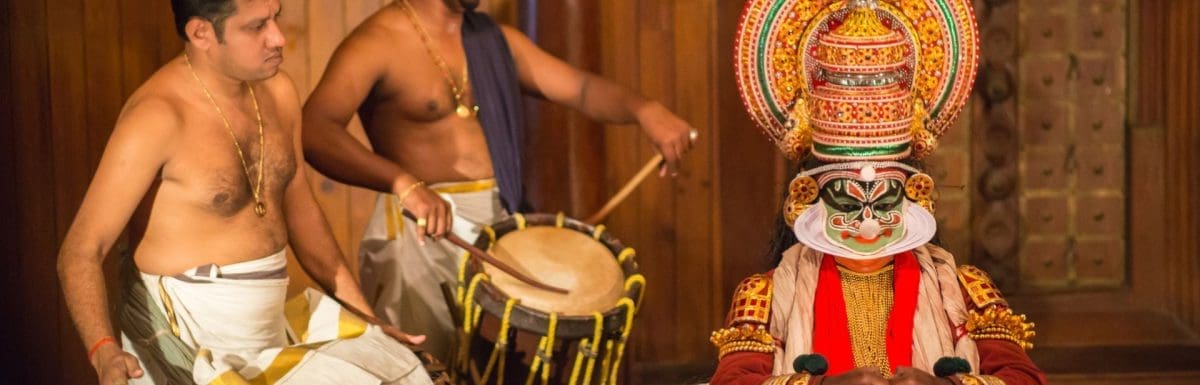
Indian classical dances like Kathakali Dance demonstrate the richness and variety of Indian culture. Kathakali is a dance and drama art that is actor-controlled. Kathakali is more than dance; it is a theatrical performance of epic stories, and in this performance, the visual, gestural, and narrative features are more important than the movement. Performances often draw from the Ramayana, Mahabharata , and Puranas – heroes, demons, gods, battles, and moral dilemmas.
ALSO SEE – Best Places to watch Kathakali in Kerala
What Is Kathakali Dance?
Kathakali is the combination of Indian classical dance and drama. Kathakali dance is the art of grace and beauty of which is in the painting of stories using motion, colour, music, hand gestures, and facial expressions. The word Kathakali is from two words from the Malayalam language: katha and kali. Katha means tale, and kali means play or performance. So literally, Kathakali as a whole means story-play performance.
Unlike the other classical dances that are solo-based, such as Bharatanatyam or Kathak, Kathakali is usually a performance and involves many expressions that narrate mostly the stories from the Hindu epics. These epics include the Ramayana, the Mahabharata, and the Puranas.
Kathakali Dance- Origins and History
Traditionally, all Indian classical dances, including Kathakali, stem from the roots of Indian performing arts, particularly the Natya Shastra, in which the foundations of Kathakali were developed. Kathakali began to take shape as an authentic classical theatre form along the lines of:
- Koothu and Koodiyattam Sanskrit theatre.
- Krishnanattam, a temple theatrical form of the life of Krishna.
- Kalaripayattu, as well as South Indian martial arts traditions.
- Elements of Kerala folk tradition and customs.
Natya Shastra of Indian performing arts can be dated roughly between 200 B.C.E and 200 C.E. Kathakali and the practices that paved the way for its emergence as a distinct form of Indian classical theatre are a much later development of the performing arts in South India around the 16th and 17th centuries, when women’s temple Kathakali was performed for a period of one year.
At first, Kathakali was performed in temples and the royal court courtyards, but nowadays, big theater houses are the preferred venues. The performances might last all night and tell different stories of gods, heroes, and demons, as well as the spiritual dilemmas involved.
ALSO SEE-Best Places to watch Kathakali in Kerala
Philosophy and Themes of Kathakali Dance
One needs to grasp the duality of metaphysical love vs hate, devotion vs desire, dharma vs sin puts forth in the story. The narrative is a mere allegory for a spiritual/moral discourse. The drama is pulling the motive, themes, and characters from Hindu religious texts and epic stories of gods, their battles, and moral dilemmas for its inspiration.
Ramayana, Mahabharata, & many others are the base pieces of the narrative. Different from the present-day theater that mainly depends on the sense of the spoken words, Kathakali tradition communicates a mostly symbolic, visual, and movement language (mudras, rasas) of dance, also delving into the sphere of music, and uses a variety of costumes.
Kathakali Performance- Unique Structure
Kathakali is more than just a style of dance; it is a style of dance drama. The performers are not merely dancers and actors; they are also storytellers through their bodies.
- Mudras (hand movements) represent a meaning or a word.
- The beautiful contours of human faces, the modulation of the eyes, is a representation of wonder, valour, and even anger, love, and disdain.
- Body movements and feet tell a story with a narrative, centered through a rhythm. There are 24 mudras, told with individual gestures, and 9 remaining among the 9 bhavas and the classic rasas
- Kathakali is famous for intense eye work and facial control- performers train to express emotions with precision.
ALSO SEE-The Rich Culture Of Kerala: Art Forms, Dance, Festivals, Food
Kathakali Dance- The Power of Wardrobe and Makeup
Very well said. One of the most stunning aspects of Kathakali is the over-the-top costumes and makeup. These details certainly make the characters stand out and help the audience to identify them.
Kathakali Costumes
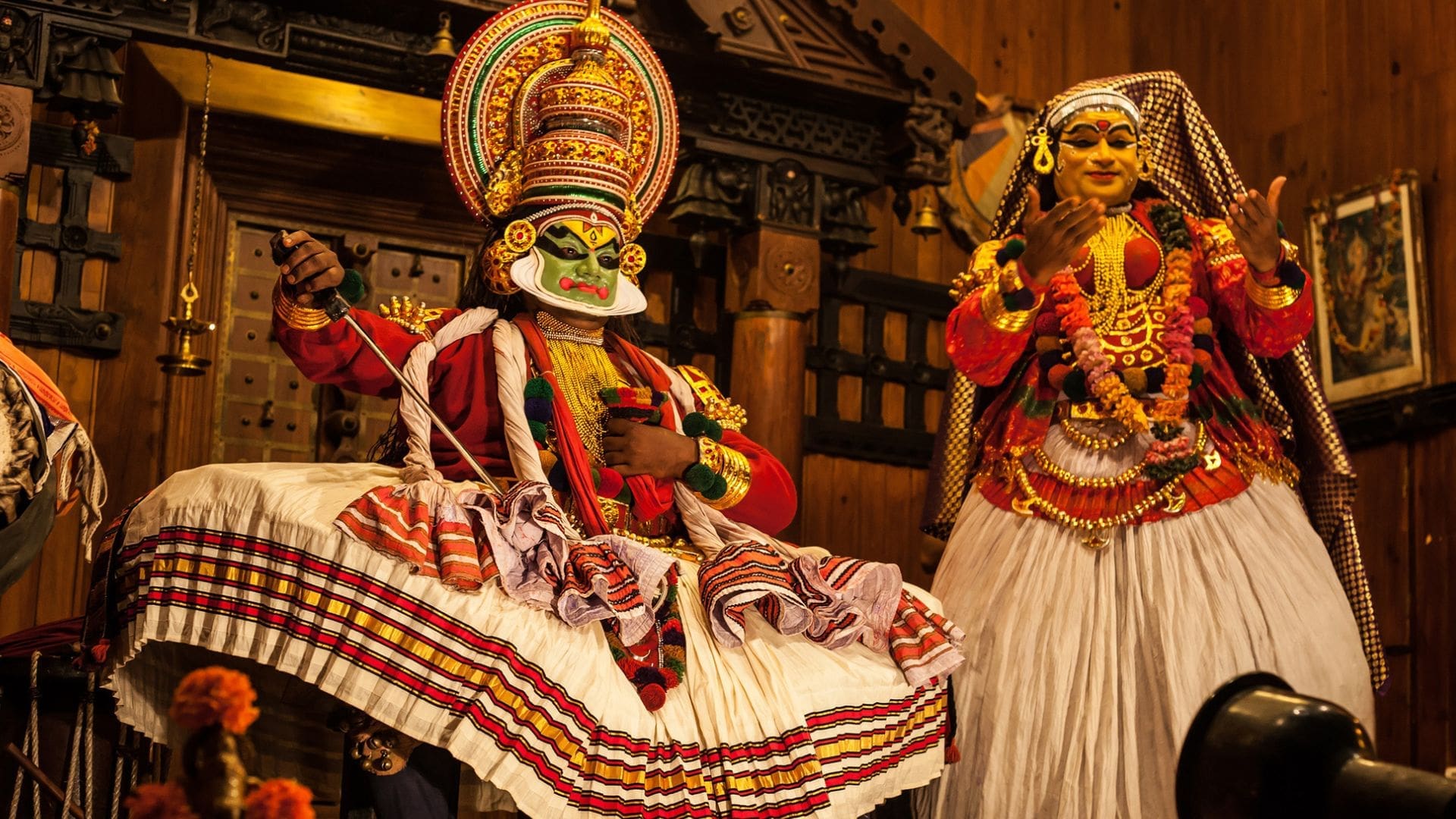
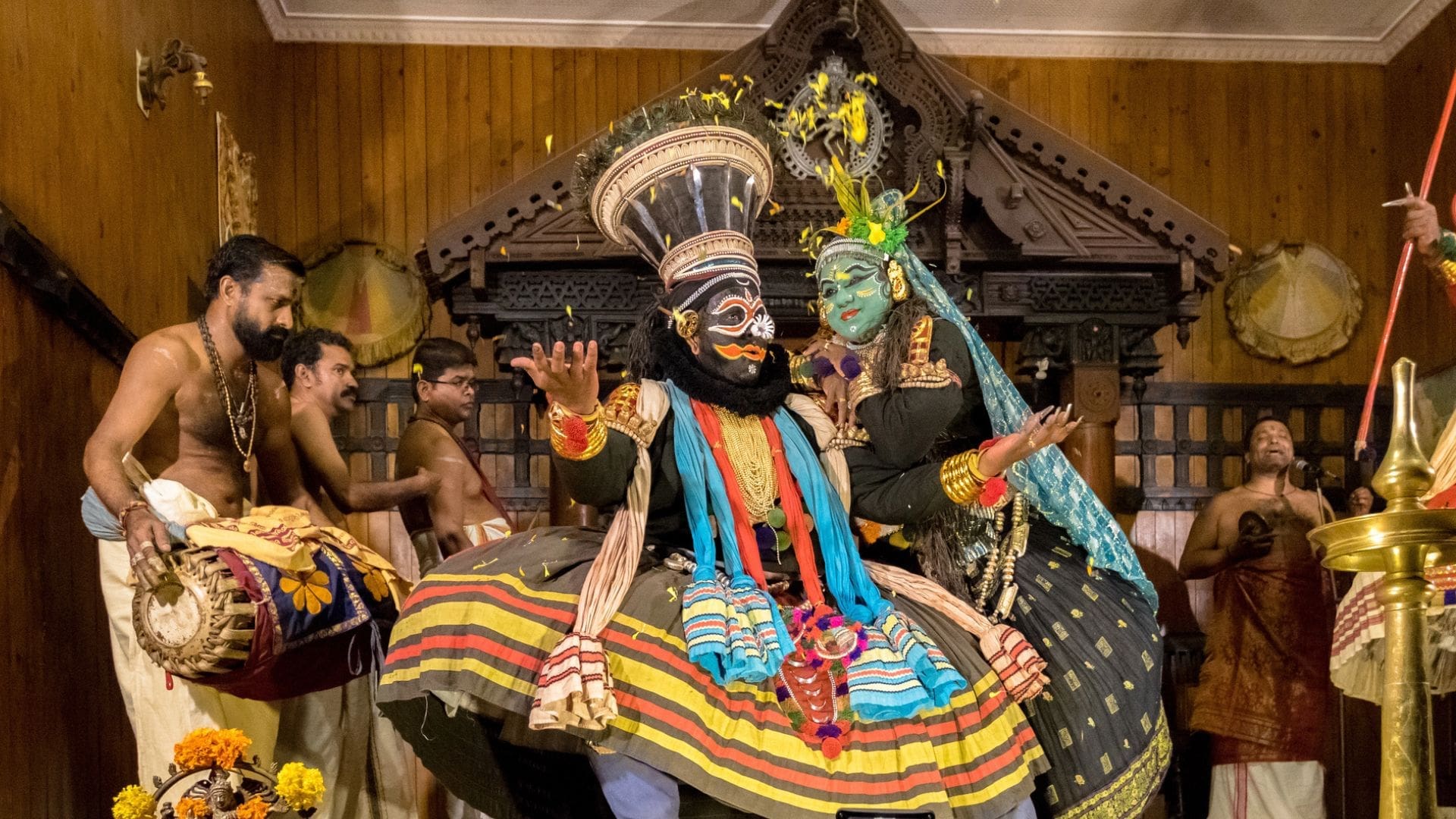
Each costume is filled with jewels and made with fancy materials to create large skirts and high hats. These details are crucial in establishing the hierarchy of the characters. Depending on what characters are wearing, you can determine their role as godly, noble, heroes, villains, or demonic characters.
Kathakali Makeup
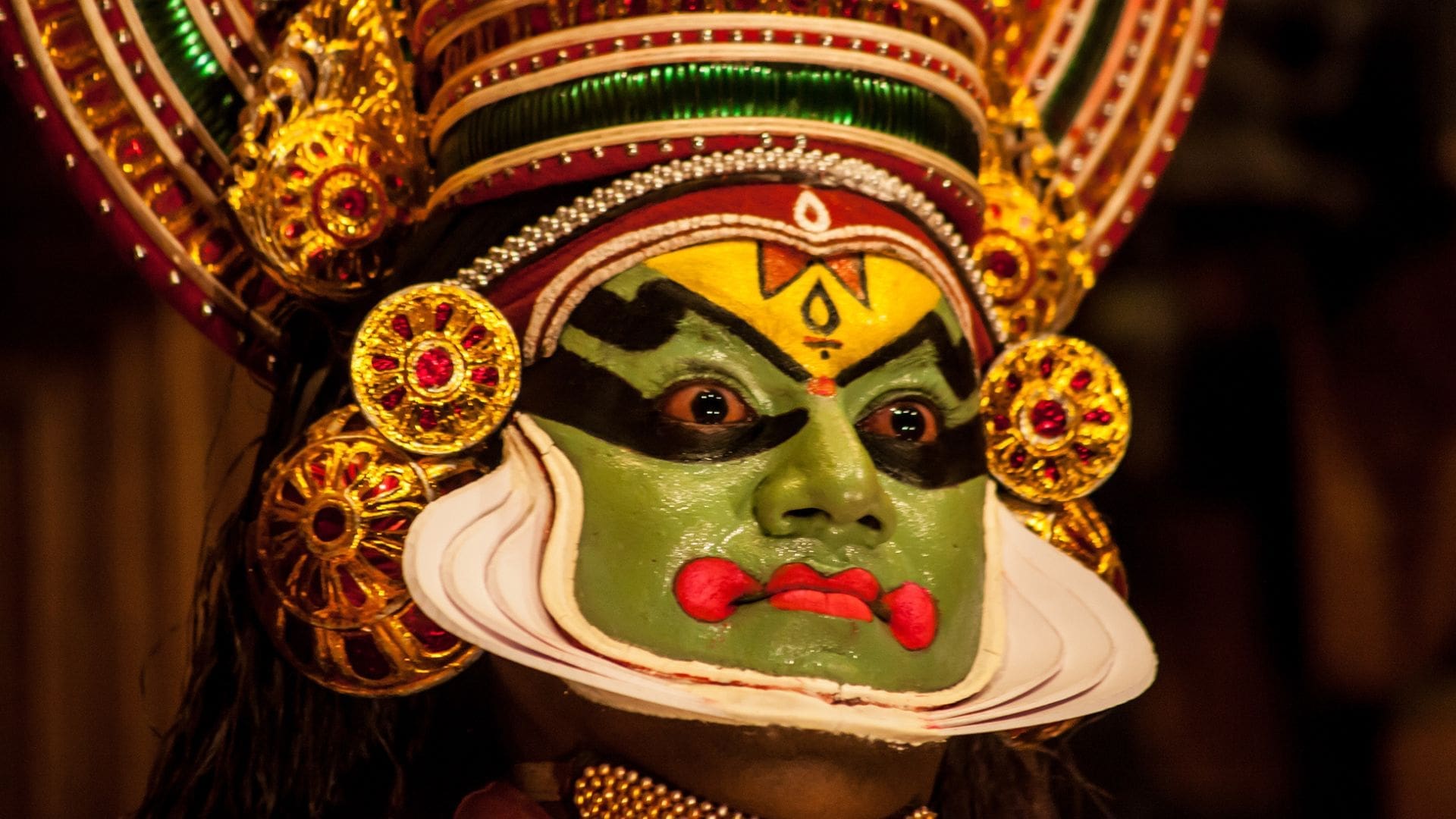
The makeup is incredibly detailed and can be seen as symbolic, and it will tell the audience a great deal of information about a character’s personality. Traditionally, the materials to make the makeup were natural and created from rice flour and herbal pastes.
The makeup in Kathakali is a code (not just decoration)
Colors and patterns tell you the character type:
- Green (Pacha) – noble/heroic
- Knife-mark face (Kathi) – proud/evil
- Black (Kari) – demonic
- Soft/yellowish (Minukku) – gentle/saintly
- Bold “beard” types (Thadi).
The Pacha hue is colored green and represents the noble heroes and gods. Kathi is the color associated with the villain or anti-heroes. Thadi is for the bearded and demons and ferocious characters, and Minukku is for the virtuous women.
This makeup is made with a lot of passion and can take an enormous amount of time, and is an art in itself.
Music and Rhythm in Kathakali
Kathakali’s music is as important as its visual enactment. There are two main components:
Vocal Music in Kathakali
The singers are placed at the edge of the stage and sing classical Malayalam verses with distinctive ragas and rhythms, relaying the story’s emotional arc and enabling performers to maintain the mood.
Instruments in KathakalI
During the dance, traditional drums and melody instruments may be played:
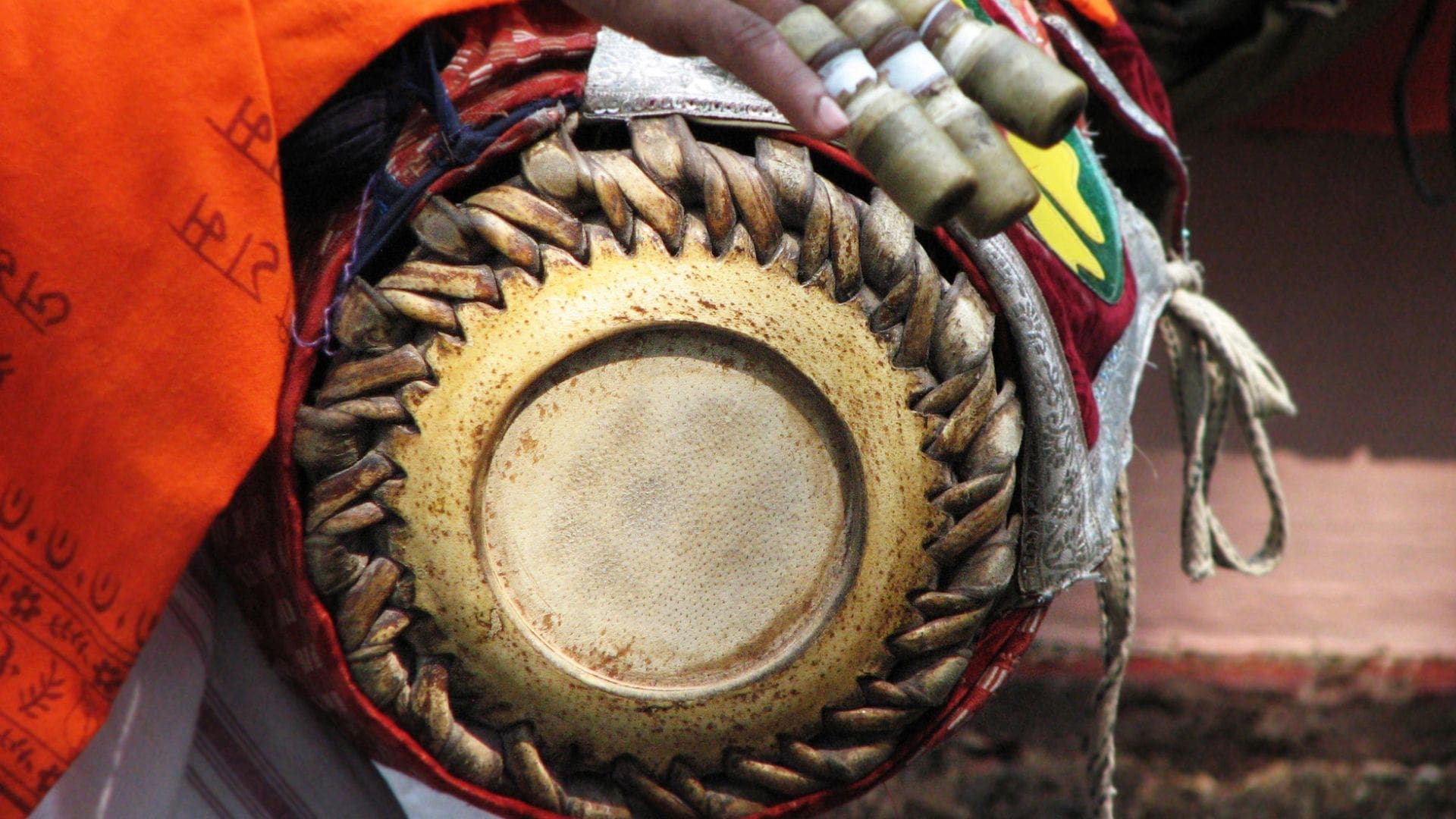
- Chenda — a loud drum used to set the rhythm;
- Maddalam — adds further rhythmic depth;
- Edakka – hourglass made drum with mild tone;
- Ilathalam and Chengila — cymbals and a gong, respectively, that accentuate beats.
Collectively, these instruments provide a rhythmic force that both compels and amplifies the theatrical goings-on.
Education and discipline: The guru–shishya tradition
You can never stop learning Kathakali. Till then, they are trained in a master-disciple tradition known as.
Training covers:
- Mudras and emotional expressions,
- Rhythmic footwork,
- Strengthening the body and eyes,
- Methods of adjusting voice in real time with singers,
- Mastering timing and physical endurance.
All of this deep training makes sure that every gesture and beat is communicating exactly what was intended.
Kathakali Styles and Schools
Like other classical Indian dances, Kathakali too has grown through several unique styles over time, mainly Kalluvazhi, which is the most advanced, refined, and formalized style. Kidangoor is the other style, and even though it is slightly changed and combined with classical, it is heavy on dramaturgy. These styles vary in the extent of choreography, gestures, and narrative, but they are all based on classical performances.
ALSO SEE- Top 10 Traditional Kerala Dance Forms That Will Enchant You!
Notable Institutions and Modern Revivals
One of the major contributors towards protecting and promoting the art form has been Kerala Kalamandalam, which played a pivotal role in systematizing the training of Kathakali teachers and artists. Besides, Kathakali artists have also been able to extend their performances beyond temple and palace environments into international stages and cultural festivals. Today, Kathakali ensembles are going to great lengths in the global arena to perform and introduce their stories to the audiences.
Social and Cultural Importance
Kathakali is not, in fact, only a performance. It represents and packs the mythological and spiritual heritage of the people that has lasted for centuries. Kathakali represents the heritage of the state of Kerala and has been a never-ending source of attraction for many artists, scholars, and fans globally. It is one of the world’s most respected classical arts and a living heritage famous for its rich, devotional blend of drama, storytelling, and dance.
Kathakali Today – Continuity and Change
Even Kathakali is firmly rooted in the traditional Eastern culture. However, modern Expansion have broadened its scope to address new themes, gender representation, and cross-collaborations among other proving its adaptation and ongoing interest.
The art form, not just in Kerala but in international cultural festivals around the globe, as audiences are inspired by the magical combination of music and dance, myths and expression that is Kathakali.
Symbolism and the Language of Colours in Kathakali
The colour code is one of the most interesting features of Kathakali, for it conveys at once various aspects to the audience. Makeup on a performer’s face is supposed to mean something. There’s nothing ornamental about the colors; they speak to a character’s moral compass, emotional constitution, and spiritual orientation.
- Green Colour (Pacha) It represents purity, nobility, and divinity.
- Red is associated with aggression, ego, and uncontrolled emotions.
- Black represents darkness, ignorance, and destructive aspects.
- Facial frames (chutti) in white, the color of Divinity and grandeur.
This nuanced language of color enables the audience, even those who haven’t read the story, to instantly grasp whether he or she is watching a virtuous abstraction or a villain. This kind of symbolism makes Kathakali both intellectually stimulating and visually striking.
Facial Expressions and Eye Movements
Face is important in Kathakali (Bhava and Netrabhinaya). Actors get trained to see and feel every single part of their face, like every bit of their eyebrows, and every bit of their eyes. This means every slight of their eye or a slight lift of their eyebrows. In other dance forms, movements are supported by expressions. In Kathakali, the opposite of this is true. One scene goes on for a few minutes, and in it the dancer portrays the feelings of jealousy, bravery, empathy, and then conveys anger and sadness without a single spoken word. This portrayal of emotions is why the dancer is referred to as a living canvas. This is what, in the eyes of many, makes Kathakali the most emotional of all theatre arts.
Ripping the Bodice: ’Kathakali Dance-Drama, Women and Modernity’
Up to now, Kathakali has been traditionally performed only by men and boys. This was because of social customs and temple practices in use for ages. Women have slowly gained access to Kathakali, breaking age-old taboos. Women trained in the art of Kathakali carry off the male roles on stage with the same vim and incredible strength as their male counterparts.
The addition of such features reflects the way classical art forms today are gradually redefining themselves. Traditions are being treated with respect, but not with repression.
Kathakali as the Cultural Identity of Kerala
Kathakali is not just an art in Kerala; it represents cultural pride and identity. Kathakali embodies the very essence of Kerala’s rich cultural detailing, right from its tourism promotion initiatives to local fests and festivals.
Performances are commonly promoted at major festivals, temple fairs, and international cultural exchanges. For natives, Kathakali is a reaffirmation of the quintessence of our cultural heritage and values; for foreigners who visit Kerala, this art form showcases the spiritual and artistic depth that always surrounded life in Kerala.
With preservation initiatives, institutions, and performances across the globe, Kathakali stands today as a living ambassador of Indian classical heritage.
Stage Setting and Performance Ambience in Kathakali
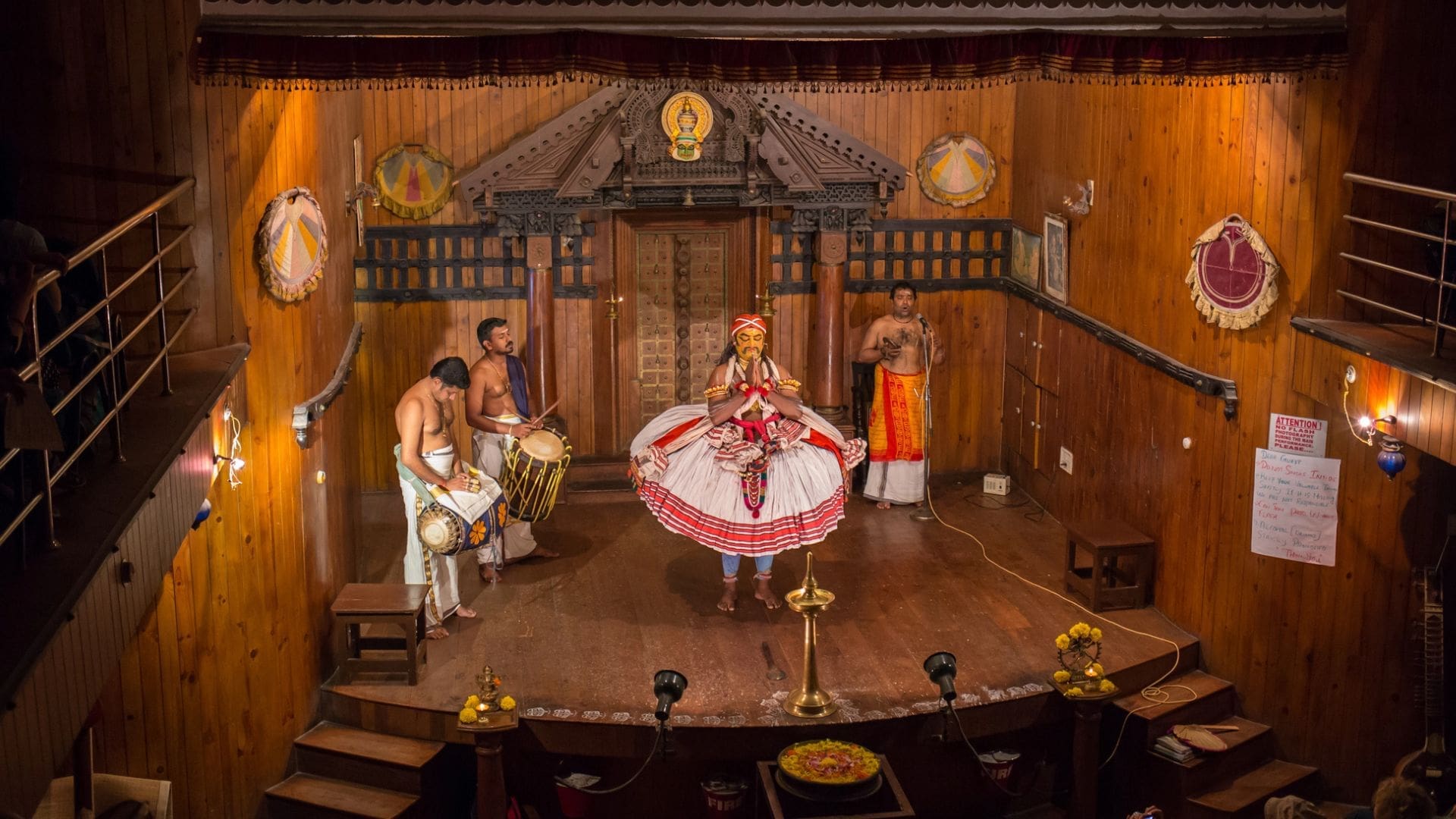
The conventional Kathakali performance stage is bare but pregnant with meaning. Unlike the modern stage with its backdrop of painted scenery, it depends on coloured lights and performance energy to achieve a dramatic illusion. In days gone by, performances would take place in temple courtyards, palace compounds, or on an open-air stage from dusk till the break of dawn.
The Kalivilakku, an oil lamp, floats at the centre of the stage. This lamp is not just a medium of light; it is an emblem or symbol of God’s presence, purity, and knowledge. The flames flicker; they make the face more expressive and cast even deeper shadows to heighten that emotional involvement.
This spare but potent staging emphasises the spiritual origins of Kathakali and keeps the story firmly foregrounded in favour of spectacle.
Problems of Conserving Kathakali in Modern Times
While it is indeed expensive and of historical significance, Kathakali is not without its set of challenges in modern times. The long performance time, extensive training commitment, and evolving audience tastes have led to a declining participatory rate, especially among the younger generation.
The modern lifestyle also tends to favor more abbreviated and expeditious forms of entertainment, so that all-night Kathakali performances are generally not routine. Not to mention, it is an art form that demands ongoing financial and institutional support along with dedicated students willing to put in years of vigorous training.
However, it won’t be losing its classical edge any time soon; within briefer performance series, educational opportunities, cultural festivals, and digital platforms, Kathakali persists in evolving. Today, preservation isn’t about freezing a tradition but allowing it to grow and develop in a responsible way.
Kathakali is a dance in which color, movement, rhythm, and myth swirl together to tell stories that resonate through the ages. Powerful and majestic, it is also one of the oldest living traditions of performing art forms in India. Whether your passion is the theatre, dance, history, or mythology, there is a richness to a Kathakali performance that is an emotional and cultural rather than political one that lingers well beyond the curtain.
Language and Texts of Literature Employed in Kathakali
Although this performance is predominantly Keralite, the literary sources draw from many cultures, all of them ancient. The songs and verses sung and recited in the performance are composed in Manipravalam, a language of Sanskrit and old Malayalam, which is why this craft of writing can hold in it a variety of sentiments, from complex reasoning to fragrant poetry.
The dancers in the stars do not sing. They do not perform any of the sections that contain the words. Dancers play the parts of the other sections, verbally sung by the trained singers, and the movement is hand and eye… The words and the movement are disconnected, a contrast that speaks to the mastery of the relationship between the musicians \\”the singer\\” and the dancer.
In using the texts of the great literary works of the past, Kathakali continues to connect with ancient Indian culture.


Leave a Reply